Your Strategic
IP Partner

Your Strategy First®

Our Purpose

The world judges us based on what they can see and touch. However, at Metayage, we believe in the true value and power of Intangible assets. The entrepreneurial journey of an innovative startup founder can be extremely challenging, especially when very few believe in your inventive ideas, and most people tell you that your ideas are worthless. At Metayage, we act as a friend, well-wisher, mentor, and a strategic IP partner to nurture your idea and protect it by getting you patents that certify that your invention is unique and inventive, and give you exclusivity. We partner with you at each stage of your journey, right from idea, prototyping and launch, fundraising, scaling up to exit.

Our Services


Metayage acts as an extended in-house IP department and also doubles up as an external IP firm

Our services encompass the entire IP life cycle right from IP Identification to Monetization

International Patent Protection

We get speedy patent grants in all major markets around the world seamlessly.

IP Due Diligence

We provide clarity on patent portfolio quality, and identify red flags and provide recommendations on reducing risks due to infringement of third-party IP rights.

Patent Intelligence

We provide actionable intelligence based on patent data for Competitive Intelligence, Freedom to Operate, and Invalidating patents of competitors.

International Trademark Protection

We enhance your brand value by registering your valuable brand names, logos, and product names as trademarks in key markets.

International Design Protection

We give you an edge over your competitors by protecting your product's unique aesthetic features in major markets worldwide.

Strategic IP Partner

We act as your extended IP department and conduct IP Audits, prepare patent intelligence reports and update your IP Strategy periodically.

Why Metayage

IntellectualProperty.

Case Studies

PI Ventures

Conducted patent due diligence on Freedom to Operate and Patentability prior to Venture Capital Investment in deep tech startup.

Saankhya Labs

Prosecuted and conducted patent valuation that includes 25 granted US patents, and patents in India, Europe, Japan, and South Korea.

Niramai

International patent portfolio in the US, EPO, India, Japan, Canada, China etc. 9 US patents granted.

Numerify

17 US patents granted, related to AI driven data warehousing and analytics for Business Intelligence.

Kernel LABS

Acted as an in-house patent counsel for their portfolio companies such as Omnivor and Trusted Key (acquired by Workday, Inc).

What Our Clients Say About Metayage

Frequently Asked
Questions

Patents have an impact on the R & D, Finance, Marketing, HR and Legal departments of a company. For R&D, it protects their investment and maximizes ROI. For Finance, it increases the valuation, generates royalties and increases profits. For Marketing, it strengthens the branding, differentiation, and competitive advantage. For HR, it enables a culture of innovation, and helps to retain top technical talent. For Legal, it mitigates IP infringement risks and secures the company's valuable assets.

Since patents are territorial/country-specific, the selection of countries/jurisdictions to apply for a patent should be based on which countries are major markets, and which countries the product is likely to be made or used in. Other considerations include, the country of incorporation, likelihood of success in securing patents, ability to enforce successfully, timelines, and costs.

An IP Strategy is a systematic roadmap to align a company's business goals with Intellectual Property related initiatives. The IP strategy depends on what stage the company is in, its short and long term goals, its competitive position within the industry, etc. IP initiatives such as IP Audits. Patent intelligence, Freedom to Operate, IP protection, IPR enforcement, IP licensing and IP valuation are conducted at different stages depending on the company's IP Strategy.

The extent and scope of disclosure in a patent application should be sufficient to successfully obtain patent protection while also preserving key trade secrets to the extent possible. To obtain a patent grant, a patent application must satisfy novelty, non-obviousness, subject matter eligibility requirements, and enablement. For enablement, every element of every patent claim should be described in sufficient detail to enable a person of average skill in the technical field that the invention relates to, to make and use the invention without undue experimentation.

Especially before launching a product in new markets, but preferably even during the R&D stage, conduct a Freedom To Operate (FTO) search in those countries where you intend to launch your product. This helps to identify patents owned by third parties that your product might potentially infringe. Once these patents are identified, analyze the claims of these patents based on the specification to determine their scope of coverage. Then you can reverse engineer your product to avoid infringement, or even look at opposing or invalidating third party patents that pose a significant threat to your business.

Typically the relationship with an IP firm starts fairly early in the journey, during R&D and product development. At this stage, your company will typically not have an in-house IP department or even an in-house IP counsel. Hence, the right guidance on an IP strategy that aligns your company's requirements with IP initiatives is crucial. Transparency and clarity in communication will help you make informed decisions. Expertise and track record in successfully obtaining IP protection is another key metric to consider. Last but not least, expertise in multiple jurisdictions is critical if you want to build an international patent portfolio

Latest Blog & Articles

View All Blogs

04/Aug/2022

5 lies you’ve been telling yourself to delay patent protection

I am too busy – The truth is that if it is important and valuable enough everyone finds time for it.

24/Jan/2021

What are the patent trends in China as compared with India?
Over the past decade, the volume of patent filing in China has seen a dramatic rise.

01/Apr/2023

What are the challenges in obtaining patent protection for software-related inventions?

Software inventions are increasingly important today because they enable automation, speed, connectivity, innovation, and effective data management. Businesses who innovate using software gain competitive advantage

Metayage
What are the patent trends in China as compared with India? | Metayage

What are the patent trends in China as compared with India?


1.What are the PCT application trends in China?


Over the past decade, the volume of patent filing in China has seen a dramatic rise. China has overtaken the traditional top patent filing jurisdictions such as the US, South Korea, Europe and Japan. In addition, in 2019, China surpassed the US as the top source of PCT (Patent Cooperation Treaty) applications filed with the WIPO (World Intellectual Property Organization). The total number of PCT applications increased by 5% in 2019, out which Chinese applicants alone filed 58,990 PCT applications. Thus, about 22% of the PCT applications filed in 2019 originated from China.

Francis Gurry, the Director General of the WIPO said “China’s rapid growth to become the top filer of international patent applications via WIPO underlines a long-term shift in the locus of innovation towards the East, with Asia-based applicants now accounting for more than half of all PCT applications”. In the global top 10 list of corporate PCT filers, four companies were Chinese companies. In 2017, China led the world as the most applications filed in the following categories: artificial intelligence, blockchain, Cybersecurity, Virtual reality and Autonomous driving. In 2019, the Chinese tech giant, Huawei Technologies was at the top of the Chinese Corporate filers by filing 4,411 PCT applications.


  • Why have applicants chosen to apply for patents in China?

 Apart from the benefit of exclusive rights in a big growing market, one of the major benefits of patent filing in China is that the average application processing time is about 22 months, with high-value patent applications being processed at an average of 17 months. China’s National Intellectual Property Administration (CNIPA) has aimed to efficiently process the documents to bring down the patent application processing time to about 13.8 months by 2022.


  • How many patent applications filed by Indian applicants have been granted?

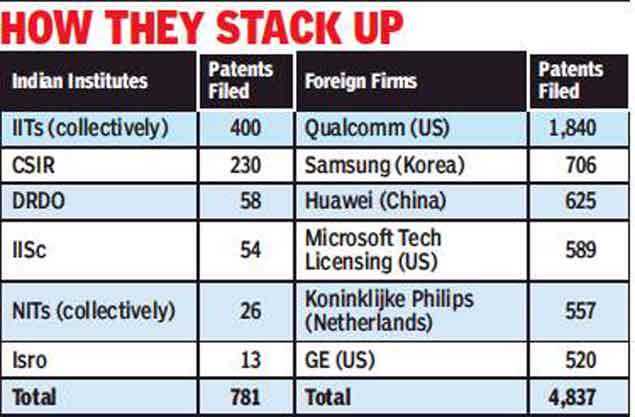
In 2019, 19888 patents that were filed by Non-residents in India were granted, as compared to 3690 patents granted to residents. Less than 1% of the PCT applications that were filed in 2019 were by Indian applicants. None of the Indian companies or research institutions made it to the global top 100 patent filers. During 2017-2018, India invested only 0.7% of its GDP in research and development, whereas China invested 2.1% of its GDP. Other technology companies such as Mitsubishi, Samsung, and Qualcomm have each filed more PCT applications in 2019 than Indian applicants as a whole.


  • What steps has India taken to expedite patent examination and reduce costs?

The Indian patent office announced several changes to incentivize patent filing in India by Indian startups and MSMEs, including reduced patent office fees, a provision for expedited examination of patent applications, and a scheme for Facilitating Start-Ups Intellectual Property Protection (SIPP) through facilitators who are compensated by the Government. The expedited examination led to startups receiving patent grants in about a year, instead of 4-5 years, which was a fantastic improvement. However these schemes have not impacted PCT or foreign filings by Indian applicants as the facilitators are not qualified to provide, or reimbursed for patent services outside India. The reimbursement amounts and payment cycles offer little incentive for experienced practitioners to offer their expertise, while the demand for their services has increased and supply is limited. Whereas the number of patent agents qualifying the patent agent examination has increased, a majority of them merely have theoretical knowledge and lack practical experience or training. Further, these benefits have not been extended to universities and research institutions, for whom the typical time for a patent grant is more than 4 years.


  • What steps have been taken to reimburse patent expenses for startups?

One scheme that was launched promote international patent filings by startups in the Electronics and IT sectors in the SIP-EIT scheme by the MEITY (Ministry of Electronics and Information Technology). Whereas approvals for reimbursement were given to a handful of startups after a presentation in Delhi and an interview process by a committee, the funds could be disbursed to only a few startups which could survive and persist for the several years to satisfy all the requirements of the scheme in a timely manner. The scheme is currently inactive and an announcement is awaited on whether it will be continued. A few state governments such as Karnataka and Kerala have launched schemes which have been fairly successful, as patent reimbursements have been disbursed for Indian patents as well as patents in the US, EPO etc.


  • How is the Indian startup ecosystem performing with respect to other startup ecosystems?

The constructive efforts of the government and the patent office are also evident from the improved ranking of India in the recent Global Innovation Index. In 2020, India jumped 33 points to rank 48th the globally, in comparison to the 81st rank in 2015. Prime Minister Narendra Modi announced an INR 1,000-crore fund for early-stage startups in the country. India now has the third-biggest startup ecosystem with 41,000 startups, and over 30 unicorns, which is a big leap from four unicorns in 2015.


  • What needs to be done for Indian applicants to innovate in India and patent globally?

The world’s largest technology companies have set up R&D centers in India, which have led to a large number of patent filings in the US. Whereas the inventors may be Indian nationals, the patents are owned by foreign companies. With funds being available for Indian startups, more funds have to be invested in R&D and creating, owning, and protecting Intellectual assets. Further, since patents are country specific, and the value of a patent is based on the size of the market, Indian companies need to patent in the largest markets, including the US, Europe, Japan, South Korea, and China.

 

Metayage